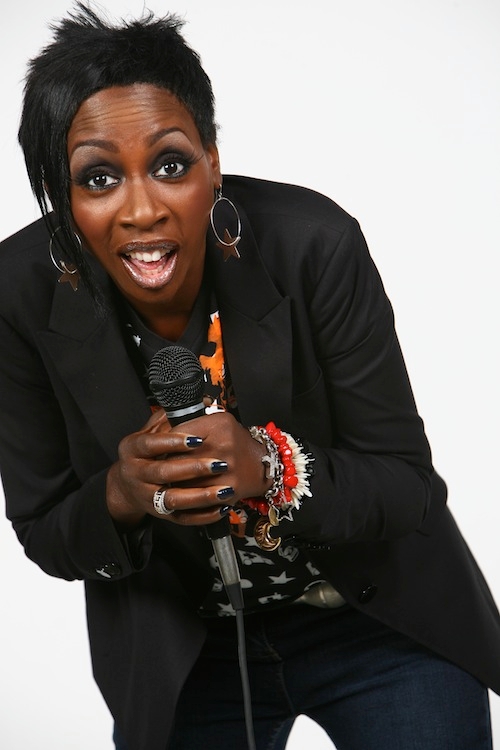
Gina Yashere: Two Cultures, Two Continents, and a Voice Entirely Her Own
Black Comedy News | Definitive Profiles — Volume 4
The art of belonging to more than one place
Gina Yashere’s comedy begins with an observation that many children of immigrants recognize: the world inside the family home can operate by different rules from the world outside it. For Yashere, growing up in London with Nigerian parents meant navigating British school life and Nigerian expectations, often within the same day. She turned that double perspective into a stand-up language that could reach audiences on either side of the Atlantic without pretending that the cultures were identical.
Her career eventually took her from British comedy clubs to American late-night television and to the writers’ room of a major network sitcom. Along the way, she became a performer whose work connected questions of migration, family, race, gender, and cultural misunderstanding. Her achievements are especially significant for a Black British comic because the routes to American recognition have historically been narrower than those available to performers already established in the United States.
London, Nigerian family life, and an unexpected profession
Yashere was born and raised in London, the daughter of Nigerian parents. She has described the difference between her life at school and the traditions, food, language, and expectations of her household. Those memories became some of her most recognizable material. A parent who appears formidable at home can become, onstage, a fully realized comic character—one whose discipline and affection are presented together rather than as simple opposites.
Comedy was not the career path originally expected of her. Yashere trained and worked as an engineer, including repairing lifts, before committing to performance. The change was not merely a switch of jobs. Engineering offered a recognizable professional identity; stand-up offered uncertainty, late nights, rejection, and a form of work that could be difficult to explain to a family that valued stability. Yashere has recounted her mother’s initial skepticism with the comic precision of someone who knows that the most demanding critic may also be the person whose approval matters most.
The technical background also offers an intriguing contrast with her later work. Stand-up can look chaotic, but it depends on engineering of another kind: setups, pressure, release, repetition, and timing. Yashere learned to organize autobiographical details into stories that traveled beyond their original setting.
Building a British stand-up identity
Yashere established herself on the British comedy circuit in the late 1990s and early 2000s. She appeared on television programs including Live at the Apollo and Mock the Week and became known for character work on The Lenny Henry Show. Her characters, including Tanya and Mrs. Omokerede, allowed her to explore social roles and family dynamics through voice, posture, and recognizable behavior.
British television provided exposure, but the live circuit remained essential. A comic working across venues has to negotiate audiences with different backgrounds and assumptions. Yashere could explain Nigerian family habits to people unfamiliar with them while also making jokes that Nigerian and British-Nigerian listeners would recognize from experience. That balance is delicate. Too much explanation can flatten a joke; too little can leave part of the audience behind. Her stage identity emerged from knowing when to translate and when to let the specificity carry the humor.
The subjects she explored were not limited to heritage. She addressed work, relationships, public behavior, racism, and the everyday absurdities of modern life. But the family stories gave her a distinctive point of view, making her more than another observational comic describing generic frustrations.
Crossing the Atlantic
Yashere pursued opportunities in the United States, where appearances on Last Comic Standing introduced her to new viewers. She also appeared on American stand-up and late-night programs, including The Tonight Show. Her experience on both sides of the Atlantic became part of the material: the same language could produce different misunderstandings, and familiar racial categories did not always travel cleanly between countries.
Her work as a correspondent on The Daily Show with Trevor Noah made particularly effective use of that position. A Black British Nigerian comic commenting on American public life brought several perspectives into the same frame. She could speak as an outsider to certain American customs without being outside the wider conversations about race and representation. The humor depended on both proximity and distance.
Yashere also produced stand-up specials, including Skinny Btch, Laughing to America, and Ticking Boxes. Her Netflix appearance in The Standups* introduced her to another international audience. Rather than wait for a single institution to define her career, she used touring, self-produced work, television appearances, and online distribution to keep building it.
Bob Hearts Abishola and the question of authenticity
A defining change came when producer Chuck Lorre was developing a sitcom about an American businessman and a Nigerian nurse. Yashere’s comedy about Nigerian family life attracted the attention of the production team. She joined Bob Hearts Abishola as a co-creator, writer, and executive producer and also played Kemi, a close friend of the title character Abishola. The series debuted on CBS in 2019 and ran for five seasons.
Her involvement mattered because the show was not simply using a Nigerian character as an occasional source of unfamiliar customs. Nigerian family and community relationships were central to its world. Yashere publicly emphasized the importance of authentic representation and casting Nigerian performers. Those commitments did not mean the sitcom could represent every Nigerian experience, nor did they eliminate the compromises of network television. They did mean that someone with lived familiarity and a professional comic voice helped shape the stories from within.
The show’s central romance between Bob and Abishola offered a conventional sitcom structure, but it created opportunities to explore immigration, work, extended family, ambition, and competing expectations. Yashere’s character Kemi contributed a different kind of comic energy: outspoken, opinionated, and deeply embedded in the community the series depicted. Behind the camera, her role as co-creator and producer expanded her influence beyond delivering punchlines.
Memoir, voice work, and a broader platform
Yashere has also worked as a voice performer in animation and published the memoir Cack-Handed, bringing autobiographical storytelling into a longer form. A memoir can do what a stand-up set cannot always allow: slow down, revisit difficult experiences, and give context to the family figures who may appear as larger-than-life characters onstage. It offers readers a way to see how a joke grows out of a life without assuming that the joke tells the whole story.
Her screen work has continued beyond Bob Hearts Abishola, including a role in Star Trek: Starfleet Academy. Such projects illustrate the versatility of a performer whose original public identity was rooted in stand-up but whose career now includes acting, producing, writing, and voice work.
Yashere has spoken publicly about her identity as a gay Black British woman of Nigerian heritage. Those dimensions are part of her perspective, but none alone defines the comedy. Her work is compelling because it treats identity as lived experience—full of contradictions, ordinary frustrations, family affection, and moments of absurdity—rather than as a list of categories.
A transatlantic legacy
Gina Yashere’s career offers a model of how a comedian can move between cultural worlds without sanding away the details that make a voice distinctive. She did not abandon her British-Nigerian perspective to succeed in American television; that perspective became one of the reasons her contribution mattered. Her path from engineering to stand-up, from British stages to CBS, and from performer to co-creator broadens the picture of what Black comedy history includes.
For a site documenting African-American, Black British, and African comedy, Yashere is an especially useful bridge. Her work reminds us that Black comedy does not have one national center. It is an ongoing conversation among places, generations, and communities—and some of its strongest voices are those able to hear several sides of that conversation at once.
Career timeline
- *1990s:* Leaves engineering to pursue stand-up comedy.
- *2000s:* Builds a British television and touring career.
- *2007: Reaches American viewers through Last Comic Standing*.
- *2010s:* Appears on U.S. late-night television and releases stand-up specials.
- *2017: Works as a correspondent on The Daily Show with Trevor Noah*.
- *2018: Appears in Netflix’s The Standups*.
- *2019–2024: Co-creates, produces, writes for, and acts in Bob Hearts Abishola*.
- *2021: Publishes the memoir Cack-Handed*.
- *2026: Appears in Star Trek: Starfleet Academy*.
Selected works
The Lenny Henry Show; Last Comic Standing; Skinny Btch; Laughing to America; Ticking Boxes; The Daily Show with Trevor Noah; The Standups (2018); Bob Hearts Abishola (2019–2024); Cack-Handed (2021); Star Trek: Starfleet Academy*.