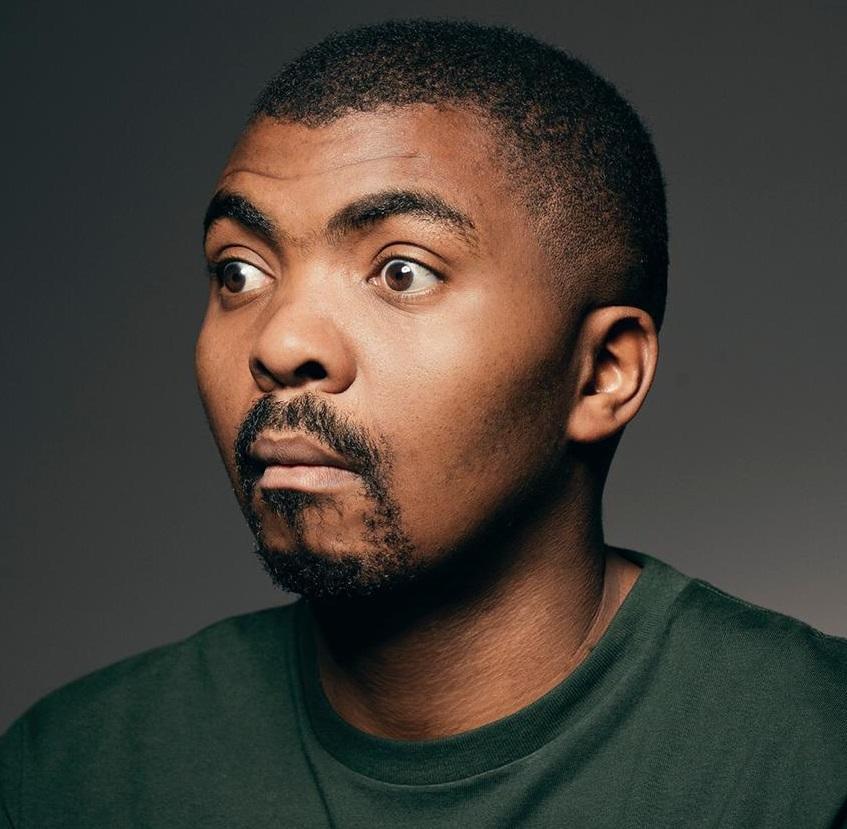
Loyiso Gola: The satirist who made the news answer back
Loyiso Gola built an international comedy career by questioning political certainty, social habits and the assumptions audiences inherit without noticing.
A comic who questions the premise
Loyiso Gola’s comedy often begins where an ordinary argument seems to end. Rather than accepting a familiar claim about race, power or identity, he turns it around and asks what hidden assumption makes it sound reasonable. That method has shaped both his stand-up and his best-known television work. It can produce an immediate laugh, but the laugh frequently arrives with an uncomfortable second thought. Gola belongs to a generation of South African performers whose professional lives unfolded after apartheid while the country continued to wrestle with its consequences. His humor does not pretend that the political transition resolved every contradiction. Instead, he treats public language itself as a subject for examination, asking what politicians, citizens and entertainers mean when they invoke history, progress or national identity.
Growing up in a changing South Africa
Gola is associated with Cape Town and the township of Gugulethu, an environment shaped by the legacies of segregation and the transformation of South African public life. Accounts of his age and exact birth year differ across published profiles, so a careful biography avoids building an argument around an uncertain date. The larger historical setting is more important. As a young South African, he encountered the promises and unfinished work of a democratic society. For a future satirist, that meant growing up amid competing stories about what the country had been and what it was becoming. His comedy later drew strength from the ability to hear those stories side by side and notice where the official version of events diverged from everyday experience.
Learning stand-up through performance
Gola began performing stand-up while still young. In a 2021 interview with The Guardian, he discussed entering comedy through a school work-experience opportunity and spending roughly two decades developing his craft. That detail challenges the myth that political comedians simply possess strong opinions and step onto a stage. Satire requires technical control: a performer must build a premise, manage an audience’s expectations and decide exactly when a provocative observation becomes a joke. Gola learned to do that through repetition, live response and exposure to different rooms. The skill became especially important as his audience widened. A reference that is immediately recognizable in Cape Town may need a different explanation in London or New York. The art lies in keeping the argument sharp without losing the audience.
Late Nite News and the television of accountability
Gola became widely known as the face and co-creator of Late Nite News with Loyiso Gola, a South African satirical news program that began in 2010. Its format placed political headlines, public statements and current affairs inside the conventions of comedy. That positioning mattered in a media culture where news programs were expected to report and commentators were expected to argue. Satire could do both while exposing contradictions through exaggeration and juxtaposition. The show was associated with two International Emmy nominations, as noted in coverage of Gola’s later work. Awards attention signaled that the format resonated beyond its immediate national setting, but the deeper achievement was editorial: it helped make comic scrutiny of public life a recognizable part of South African television.
Why political comedy is difficult
Political satire carries a special risk. A comedian can become so invested in a position that the joke stops being an inquiry and becomes a slogan. Gola has spoken about the importance of maintaining distance from political insiders and the information networks surrounding them. In his Guardian interview, he contrasted the immersion required for a topical news show with the freedom he sought in stand-up. The distinction helps explain his artistic development. Television satire must respond quickly to events; a touring stand-up set can examine patterns that outlast a single news cycle. Neither form is inherently more serious. They simply ask different questions of the audience: what happened this week, and why do we keep thinking this way?
An international stage
As Gola’s career developed, he performed for audiences outside South Africa, including in Britain. International touring gave his work a different perspective. In a home audience, a comedian can rely on a shared memory of institutions, accents and public personalities. Abroad, the performer must decide which details to translate and which to leave intact. Gola’s success rests partly on refusing to flatten South African experience into generic international material. Instead, he uses the specifics of his background as a route into broader subjects such as masculinity, prejudice and social conditioning. The audience may not recognize every reference, but it can recognize the underlying habits of thought. This approach turns cultural difference into an invitation to think rather than a barrier to understanding.
Unlearning: a special built around revision
The 2021 Netflix special Loyiso Gola: Unlearning distilled this philosophy into a title. Netflix describes the show as exploring race, identity, politics and an embarrassing school prank. In interviews around its release, Gola framed unlearning as a process of examining attitudes acquired during childhood and carried into adult life. That is a richer premise than simply declaring certain beliefs wrong. It recognizes that people inherit ideas through family, school, culture and fear, often before they are equipped to evaluate them. Comedy provides a way to revisit those lessons without pretending that the revisiting is painless. The special also placed a distinctly South African voice on a global streaming platform, demonstrating how local histories could support an international stand-up narrative.
The meaning of an uncomfortable laugh
Gola’s comic technique often relies on the audience recognizing itself in the target of the joke. The person being questioned may be a politician, but it may also be a viewer who has accepted a convenient stereotype or repeated an inherited explanation. That is why his work can feel argumentative without becoming a lecture. A good satirical joke creates a temporary gap between what a person believes and what they are suddenly able to see. Of course, audiences disagree about where satire should draw boundaries and whether individual jokes succeed. A serious assessment of Gola’s work leaves room for that disagreement. His achievement is not that he settles difficult questions, but that he repeatedly makes them available for public examination through performance.
Beyond the news desk
Loyiso Gola’s place in Black comedy history extends beyond his television program or any single special. His career connects post-apartheid South African satire, the discipline of live stand-up and the global reach of streaming entertainment. It also demonstrates that a comedian need not choose between cultural specificity and international relevance. The questions he raises about identity, learned behavior and authority travel precisely because they emerge from a clearly situated perspective. As South African comedy continues to evolve, his work offers a model of how a performer can interrogate public life without becoming permanently trapped in the headlines. His enduring contribution is a style of comedy that treats laughter as the beginning of a question rather than the end of a conversation.
Career timeline
- Early 2000s: Begins developing stand-up as a young performer.
- 2010: Late Nite News with Loyiso Gola launches.
- 2010s: Program gains international attention and Emmy nominations.
- 2010s–2020s: Tours internationally and develops longer-form stand-up.
- 2021: Releases Netflix special Loyiso Gola: Unlearning.
Selected works and projects
- Late Nite News with Loyiso Gola (satirical television)
- Loyiso Gola: Unlearning (Netflix stand-up special, 2021)
- International stand-up performances