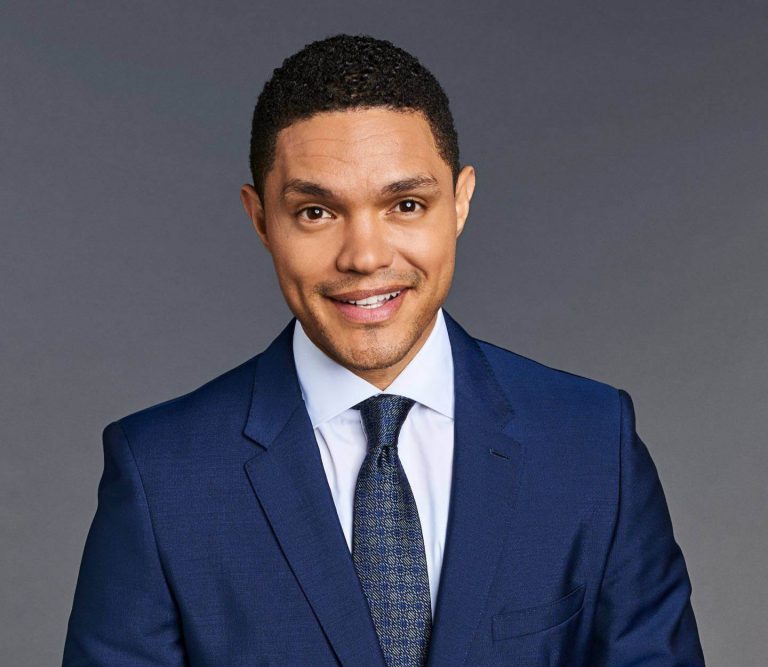
Trevor Noah: From apartheid South Africa to a global comedy conversation
Black Comedy News | Definitive Profiles — Volume 7
The art of explaining a divided world
Trevor Noah’s comedy often begins with a misunderstanding. Someone hears an accent incorrectly, assumes a stranger belongs to a particular group, or discovers that a rule considered natural in one country seems absurd in another. Noah turns that distance between perspectives into material that is funny, but also revealing. His journey from South African stand-up to hosting an American political satire institution gave him an unusual vantage point: he could explain the United States to itself while reminding viewers that American debates exist within a much larger world. His career now spans comedy specials, books, television, podcasting, and production. At the center is a storyteller whose personal history taught him early that identity is shaped by laws, language, family, and the often unpredictable way other people see us.
Childhood under apartheid
Noah was born in South Africa in 1984, during apartheid, to a Black South African mother, Patricia, and a white Swiss father. The system’s restrictions on interracial relationships gave his later memoir its title: Born a Crime. That phrase is not merely a provocative literary device; it captures the legal environment into which he was born. In his accounts of childhood, Noah describes navigating differences in language, neighborhood, and social expectation while his mother worked to create opportunities within an unequal society. The comedy that grew from those experiences is rarely a simple recital of hardship. Instead, he pays attention to the inventive ways people adapt, conceal fear, improvise, and preserve dignity. His mother’s resourcefulness is one of the recurring moral centers of his storytelling.
Language as a survival skill
A striking feature of Noah’s performance is his use of languages and accents. He can shift voices to demonstrate how a conversation changes when one person assumes another cannot understand them. That ability is more than a technical flourish. In South Africa, language has long been tied to identity, geography, and power. Noah’s childhood stories show how speaking to someone in a familiar tongue can transform suspicion into recognition, while a misunderstood accent can expose prejudice. Onstage, those shifts become both character work and social analysis. Rather than giving a lecture about the politics of communication, he lets audiences hear the problem unfold. The method helps explain why his material travels internationally: the specifics may be South African, but the experience of being misunderstood is widely recognizable.
Finding a stage in South Africa
Before American television made him globally familiar, Noah developed his career through South African entertainment and stand-up. Performing in a country undergoing rapid political and cultural change gave him a rich set of subjects, from everyday relationships to national contradictions. His comic voice combined quick observation with extended storytelling, often placing himself inside the situation rather than above it. That choice matters because an audience is more willing to follow a difficult subject when the narrator is also willing to appear foolish or confused. As his reputation grew, he performed internationally, learning how to adjust references for listeners who did not share his background. The task was not to remove South Africa from the act, but to explain its social logic without draining the jokes of their surprise.
Crossing into American comedy
Noah’s rise in the United States was remarkable partly because the country’s late-night comedy system had its own established conventions. His perspective came from outside that tradition, even as he understood its rhythms. The Recording Academy’s 2020 announcement notes that he joined The Daily Show as a contributor in 2014. That position offered a bridge between international stand-up and American television commentary. When he succeeded Jon Stewart as host in September 2015, he inherited a program closely associated with a particular voice and era. The challenge was not simply to imitate the previous host successfully. It was to establish why this different performer belonged in the chair, and how a global perspective might change the subjects and assumptions of the show.
Reimagining The Daily Show
Noah hosted The Daily Show from 2015 through December 2022. During those years, the program covered elections, social movements, international events, and the transformation of media itself. His delivery often emphasized curiosity and the contradictions of public language, while correspondents and digital segments expanded the show’s reach beyond the nightly broadcast. The Recording Academy described the program’s investment in social video, podcasts, and other digital work as part of its evolving identity. Noah’s tenure should not be reduced to comparisons of ratings with earlier eras: television consumption was changing, and the audience for political comedy increasingly encountered clips on phones rather than full episodes on television. His achievement was to make an outsider’s viewpoint central to a major American institution.
Born a Crime and the power of memoir
Published in 2016, Born a Crime: Stories from a South African Childhood brought Noah’s narrative strengths into a different form. The book centers on his upbringing and especially his relationship with his mother, moving between comic misadventure and the harsh structures of apartheid and its aftermath. Its success demonstrated that readers were interested not only in Noah’s opinions about current events but in the experiences that shaped how he interpreted them. The Recording Academy identifies the memoir as a number-one New York Times bestseller and notes its literary recognition, including the Thurber Prize for American Humor. The audiobook, narrated by Noah, is particularly suited to material in which voice and language are central. It allows the reader to hear the shifts of character and accent that the printed page can only describe.
Stand-up beyond the news cycle
Although television made Noah a familiar political commentator, stand-up remained a separate creative home. Specials such as Afraid of the Dark, Son of Patricia, I Wish You Would, and Where Was I show his continued interest in travel, identity, misunderstanding, and the comedy of social conventions. A long stand-up performance gives him time to develop an anecdote beyond a headline and let a small detail return later with a different meaning. The Recording Academy has recognized his comedy recordings with Grammy nominations. His international tours also demonstrate the unusual portability of his approach: the audience need not agree with every observation to enjoy the process by which he uncovers an assumption and turns it into a story. Stand-up is where the global perspective becomes personal again.
A second act in books and audio
After leaving The Daily Show, Noah continued to work across media rather than treating his departure as a retreat from public conversation. His podcast What Now? With Trevor Noah uses extended interviews to explore ideas without the time constraints of a television monologue. His official biography also identifies the book Into the Uncut Grass, published in 2024, as part of his writing career. These projects share an interest in conversation and imaginative perspective, even though their audiences and formats differ. His production company, Day Zero Productions, extends that curiosity behind the camera. The company’s projects point toward a career in which Noah increasingly helps shape stories beyond those he personally performs. The shift from host to creator and producer is significant because it broadens the kinds of voices and narratives he can support.
The Grammys and a global stage
Noah’s ability to manage a room also made him a recurring host of the Grammy Awards. According to the Recording Academy, he hosted the ceremony six consecutive times from 2021 through 2026, with the 2026 broadcast announced as his final year in that role. Awards-show hosting requires a different kind of comic judgment from stand-up or political satire. The performer must be lively without overwhelming the event, respond to surprises, and make artists and viewers feel part of the same occasion. Noah’s repeat invitations reflect the industry’s confidence in those skills. The role also placed a South African comedian at the center of a major American entertainment ceremony, another example of how his professional identity has crossed national boundaries without losing its origins.
The continuing story
As of 2026, Noah’s official site lists further stand-up and production work, including the Netflix special Joy in the Trenches. Specific release schedules and future projects should be checked against current official announcements rather than treated as permanent facts. The larger arc of his career, however, is clear. A child born under apartheid became an international performer by learning to interpret the boundaries that other people treated as fixed. His comedy is not without debate or disagreement, particularly when it enters political conversation, but its central method remains consistent: change the angle of view and familiar assumptions become strange enough to laugh at. For BlackComedyNews.com, Noah’s career is an essential bridge between African comedy traditions and the international entertainment industry.
Career timeline
- 1984 — Born in South Africa during apartheid.
- 2014 — Joins The Daily Show as a contributor.
- 2015 — Becomes host of The Daily Show.
- 2016 — Publishes Born a Crime.
- 2022 — Concludes his tenure hosting The Daily Show.
- 2024 — Publishes Into the Uncut Grass.
- 2026 — Hosts the Grammy Awards for a sixth and final consecutive year.
Selected works
- Born a Crime
- The Daily Show with Trevor Noah
- Afraid of the Dark
- Son of Patricia
- I Wish You Would
- Where Was I
- What Now? With Trevor Noah
- Into the Uncut Grass
- Joy in the Trenches